Thursday, November 26, 2009
Be Thankful
I just read this incredible essay from the New York Times. The essay is written by Afghanistan War veteran Erik Malmstrom, who is currently studying at the Kennedy School of Government and Harvard Business School. The essay, which reflects on loss in the war, is written simply and eloquently. Read this article, and be thankful for what you have this Thanksgiving.

Wednesday, November 25, 2009
No Turkey Day for Jon
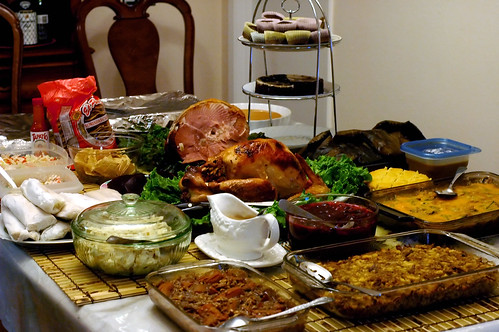

While I could list in detail all the ways in which this year is different than last year, I won’t. Previous writings have already shown the differences, and it would be redundant to go through it all again. But instead, let’s just focus on a single point. Thanksgiving is coming up tomorrow, and I think I’m going to feel pretty homesick on this occasion. It’s not that Thanksgiving was ever a particularly important holiday in my family, but just the idea of doing something very American and being with family, or friends, is something to be desired.
For years we would pile into a car and drive down to Brooklyn, beating the traffic if we were lucky and arriving hours too early. We didn’t even have a traditional big turkey, because for some reason my grandma always wanted to cut it up the night before, causing it to dry out hours before it was ready. And in the last couple of years that I was home, my dad would take my brother and sister and a couple of cousins out to a bar and for shwarma in the Village later at night.
Last year was my first Thanksgiving away from home, but it really wasn’t all that bad. On Thanksgiving day I was actually climbing Chimborazo volcano with a friend, heading up with the last iceman of Chimborazo. I didn’t even realize it was Thanksgiving until later that day after we had come back down the mountain. I went back to Cuenca the next day, and that following Saturday my friend Lauren hosted a feast at her host sisters’ apartment, along with several Ecuadorians and a few gringos in the mix. It was also the night I met my good friend Jamie, which I can use as a bookmark later events throughout the year.
I was away from home but it didn’t really matter much because I formed a group of volunteers who were also away from home. So we at least had each other in that regard. And obviously I am now alone in Buenos Aires. I know a handful of expats here, but they are either English or vegetarians, and no one has even mentioned Thanksgiving. Even if someone had, I don’t know what we could do. It’s hard enough to find just sliced turkey breast at the supermarket, let alone a giant turkey fit for a holiday meal.
I don’t generally get homesick, and I try not to think about being at home so that I can enjoy myself in the moment. But I will definitely be missing being at home tomorrow afternoon. While I’m at work, dodging the humidity, everyone back home will be rubbing their bellies and picking their teeth while plopping down on the couch to watch a terrible football game (most likely involving the Lions). I don’t even have a couch, nor can I watch football games at home anymore.
So after work is over I’ll most likely come home and fry up a steak, to enjoy Thanksgiving in the Argentinian fashion. It’s not an ideal situation, but it’s the best I can do with what I’ve got.
Above: Photo by Joits
Get Your Own Culture!
How does one truly describe what culture is? You can go across the sea, visit museums, drink different wines and eat different foods, all in an attempt to get some culture. Listen to classical music, watch a foreign film, or see a play. Whatever it is that makes you think differently, well, that might just be on the right path. In my time overseas I’ve often had to explain that the United States doesn’t really have a culture of its own, partly because it’s such a young country and because it has borrowed from others because of the immigrants who settled there. Many Americans feel the same way. We are a “melting pot”, so they say. I haven't really believed in the whole "melting pot" idea since high school, but I at least thought that we had an eclectic gathering. However, as of last night, my thoughts on this have changed.

I was fortunate enough to get free tickets to dinner and a tango show at El Viejo Almacén, the oldest tango club in the city, founded in 1969. It’s also considered one of the best tango clubs around. I’ve been sort of a naysayer about tango since I got here, seeing only the street performers, and viewing it as a show put on only for the tourists. Not many Argentinians actually dance it, taking away from the authenticity of it in my eyes. But on Sunday at the San Telmo fair I heard a street band perform, and I could actually hear the pain in the songs. I was intrigued. Then I saw the show last night.
I’ve converted now. I wouldn’t say I love tango, but I appreciate it as an art, and just watching the dancers spinning and flying through the air proves that it takes work and dedication. I still think it’s for the tourists, especially after the show when a singer said good night in 15 languages, but there’s a clear difference between street performers and club performers. They deserve the high prices that are charged on the tickets.

Anyway, there are three main things that come to my mind when I think of Argentinian culture: steak, wine, and tango. You can also throw in soccer, hand gestures, etc, but before coming down here while planning a trip with my friend Kristine, we agreed on those three things over and over. Tango is a big part of Argentinian culture, so last night during the show I started thinking. Why does Argentina have such a rich and obvious culture, while the United States doesn’t? Both countries were built up by immigrants, and Argentina is younger than the U.S. The U.S. doesn’t have “typical” food, perhaps, but Argentina has just as many pizza shops, Chinese restaurants, and other international food options as well.
I can no longer say that the U.S. has no definable culture because I think the truth is that we have one that is clear cut, but we simply do not like it and thus close our eyes to it. Some cultures involve late night dinners and all night dancing, others include famous dances or folk songs. Ours is a more plastic culture. We have fast food, malls, long work schedules, and reality TV. Our culture is one that creates contempt in people around the globe because it lacks any significant contribution to the world, and when we can’t understand why they don’t like our culture, we assume it must be that they are jealous of our successes.
We don’t limit ourselves to borrowing from other cultures, but we impose ours on others. On Avenida 9 de Julio in downtown Buenos Aires, right by Avenida Corrientes, there is a giant McDonald’s. Just down the street there is a big Burger King. And just a few doors down from that Burger King, is another McDonald’s. My only guess could be that the 2nd McDonald’s is a back up in case too many fat people try to leave the first at the same time and get lodged in the door frame. This is what foreigners see as our culture. Some like it, others don’t.
But if we are to expect that other cultures are founded on dances, songs, and lifestyles, then we must accept that ours is defined by the same characteristics. It might not be glamorous, but ours is a castle built on greasy food, hard work, and cheap television programming. And how long will those pillars hold?
Above: El Viejo Almacén
Canary in the Coal Mine
This following story was written by my friend Lewis ‘Lucho’ Wheelwright. I met Lucho in Cuenca Cuenca
I think that every traveller at heart feels restless. It’s the kind of feeling which originates from passion, and is driven by unrelenting desire. It grabs you, lets you know it’s there, and shakes you by the shoulders as if to tell you to return yourself to the unknown. It is a time when majestic photos of sprawling white mountain ranges, every word of Kerouac or Thoreau speaking of the great vastness and the “ success unexpected in common hours,” and every leathery sun-worn local face leaves us with a deep and inexplicable aching of the soul. The feeling from the gut, much as if jumping unknowingly from a plane, giving one the mentally confused, sensory overloaded, stomach dropping feeling which slaps you into a stupor. The legs bounce and a primordial voice whispering “move.” The heart beats, and then it passes until subconsciously stimulated again.
I am not a stagnant individual, nor am I one who is willing to settle. I would not fall, even though I might wish, under the category of “mochilero” or backpacking vagabond. Although I dream of the worn travellers shoes, with toes ignobly poking out, a road-weathered face only broken by the circular 1950s goggle shape from too much foreign road dust. No, no such nomadic meanderings have I completed, yet I would describe myself as itinerant; rather, ‘pata caliente’ or literally, hot-footed and restlessly adventurous, but stable for periods at a time.
It is when the internal sands stop moving that this inner goliath grabs you and screams for something new. It burns to be let out of its comfort zone and begs to be placed on the wire. If to be just running for a bus, wide-eyed and nervous. The only real answer is to feed its insatiable hunger for something. Perhaps just a lick of burned earth wafting through a window, a lazy, loosely connected ceiling fan blowing in rank humid city air, or the jittery feeling of unfamiliar streets is that prescription which kills the voracious beast. Perhaps just a new type of frosty brew, maybe one like
Last week I completed my first full year here in
If I have realized anything throughout my last year here, it’s that the simple things in life are what I miss. Although, I might go so far as to say that it’s the simple things in life that keep me here as well. True, a brilliant, colorful fall will never been seen in Ecuador, but the pace of life, the fingertips of the wild creeping at the city’s edges, and the forever lasting summer is one of the things that makes this second home so appealing.
I frequently wonder why I left the amenities of my
Even as I wait for these possibly unattainable desires I realize that perhaps this is not the goal. There is ample time down here on the equator, plenty of warm faces, as well as rich communities and history in which I can peaceably pass my time. Yet I am feeling my feet itch and I am no longer passing my time peaceably. It’s as if to have a great urge to use the bathroom on a bumpy road, jammed between 5 non-English speaking passengers in a hot and overcrowded car. Uncomfortable at best. So the true question that lies at the heart of all of this is how to pass this feeling. The truth really is that I am living it in this moment, and my thoughts of returning to my homeland, moving to another country, or just a simple vacation are all running through my head. Which one will calm the urge, and tame the beast I do not know. I feel that this is a point which many arrive to, can perhaps delay for a while, but must eventually face. The challenge is with what, and more importantly, when will our “hot-feet” cool down, and allow us peace and tranquillity in being comfortable somewhere. Or better yet, do we want this?
By Lewis Wheelwright
Sunday, November 22, 2009
Touristing

Getting out of the office was great and really gave me a better view on parts of the city I hadn't yet seen, allowing me to do my job better. Even with a lousy weekend (weather-wise) I kept up with the touristy things. On little sleep Saturday, I went with some friends to MALBA, or the Museo Arte Latinoamericano de Buenos Aires, to get a little culture. The main draw was the Andy Warhol exhibit, which is on display there from October to February, showing his famous work, including the cans of soup.

Today I went back to El Zanjón to get a more comprehensive tour, as I was invited back by my guide (and new friend) Tami. After touring through the facilities again, we walked around San Telmo's street fair, seeing tango performances and a tango band perform modern songs. Though it's extremely touristy and I've only been there 2 or 3 times for that reason, it was interesting being there today. Again, the weather was weird and gray, but altogether pleasant. We wrapped up San Telmo with some good pizza at Sr. Telmo, then headed up north to Tami's neighborhood.
The neighborhood was very residential--green with trees everywhere, parks, and a few cafes, it was a place that no tourist will ever go. Some ambassadors live there, and mansions line the streets. We sat in the park as a drizzle started to fall, and it was hard to imagine that it was still Buenos Aires. I really need to get out of the center more often. I think that to date, that neighborhood was one of my favorite places in the city. But I'm sorry, I'm not going to say where it is. I'd prefer, selfishly, to keep it a secret so that it doesn't become clogged with tourists. Not that I'm so egotistical as to imagine that this blog holds any serious power, but sometimes there is a special corner that you just want to keep like a secret. This one stays with me, and maybe a few good friends.
Thursday, November 19, 2009
Has Technology Ruined Us (Me)? or: Damn Math Part 2

I don’t know if I’m alone on that one. Has technology totally done us in? People can’t even figure out tips anymore unless their cell phone has an option for it. I think about going to the movies. I love going to a theater to watch a new movie. There’s something so exciting and special about it that I’ve felt since I was a kid. You walk into this room in the dark, look for a seat as your shoes squeak off the sticky floor, and wait patiently. There’s the key—patience. The movie plays at its convenience, not yours, meaning you have to actually want to see it, not just put on a movie at any time because you are in front of the TV.
Maybe you’ve got some snacks or popcorn, an enormous soda. The screen goes a bit to the side and people yell, but it gets fixed. The noise of the projector at the back of the room, and the imperfect sound. These minor things that retain the human element, and remind you that you are in fact, simply watching something, but not involved. We used to have trivia to entertain us as we waited, though now it’s commercials, and they keep coming up with more complex food and ways to make you feel like you’re at home. But if ask me, I want to feel like I’m out and doing something. If I’m watching the movie at home, I’ll pause it and go to the bathroom. At the theater, I wait until the end.
But going to the movies isn’t such a simple thing anymore, mainly because of the technology. I imagine in the 1930s, people would pack movie theaters and watch the news reels before the show, talking of FDR and the New Deal, why you should buy government bonds, and how the Germans were preparing for war as the crowds grumbled. Cinemas were packed because it was a special evening out, and you weren’t able to go see a movie at home after leaving. It was a treat.
Now, you don’t even have to leave your house. Who can blame you? Movies cost $10.50, or whatever they are by now. You have to deal with 10 commercials before the previews, which used to be the best part because it gave you a reason to come back. But you don’t have to anymore. Blue Ray and On Demand killed the DVD and rental store which killed the VHS which killed the cinema which killed Vaudeville which killed plays and the opera which had been performed since Ancient Greece. You no longer have to use your imagination because the studio tells you exactly what Outer Space is like. For 2 hours in your living room while watching Apollo 13, you are in Space, or whatever they say it is.
I had Slingbox for a couple of months until the new software update somehow backfired and no longer will allow me access to TV from the United States. Slingbox used to let me watch shows and movies from my lap top in bed, a comfort which has totally taken away the allure of going out for a new show. It’s broken now which is certainly disappointing, but on the other hand, it will get me to look for something else to do again. I read so many books in Ecuador when I had no TV. There’s always something to see in Buenos Aires. And I might just take myself down to the movie theater to see what’s playing.
Above: Photo by thelightgatherer
Has Technology Ruined Us (Me)? or: Damn Math Part 1
In the 10th grade I started getting math tutors when it became obvious that I sucked at equations. I was fine in other areas like English, history, etc. But math just continued to get harder and harder, and I wasn’t improving. Initially, I was pretty good at math, and I even got a 100 on a test in the 2nd grade (still proud of it). Once we hit division, however, it was a downward spiral. I hated the fact that I had to have classes after classes, and I resisted with all of my power. 
Ms. Van Dyke would come for an hour a week at 7 pm, and being a brat, I’d hardly show interest. Once I even heard her tell my mom that she knew I didn’t want the lessons and resented her. The same kind of thing went on throughout high school with two other tutors, though I was trying to at least understand the math as time went on, at least to improve my grades. Even with strict determination, an extra hour a week wasn’t enough to truly help me understand the material, maybe just finish my homework with some assistance.
Then as a senior, my friendly teacher Mrs. Goodman, who did her best to just pass me through, warned me that I should avoid taking math in college. It was pretty clear what she was saying: You suck at math and numbers should have a restraining order against you, do not go within 100 feet of a protractor. One math course my first semester in college and I was done, finished forever. All of the nonsensical equations I had learned throughout my youth floated out of my head, and any time I needed to do some dreaded math, I trusted the calculator or a smarter friend.
That is until recently, when I had to delve back into my arch enemy’s territory for the GRE. It seems so unfair that I should be tested on material I haven’t looked at in 5 years, especially when it will have NOTHING to do with what I want to study a Masters degree in. It’s just not right, and the grades on the prep book tests show that any lingering memories of algebraic basic knowledge have long since left with so many other brain cells that I parted ways with in college. But a friend who used to teach math at Sylvan Learning Centers in the U.S. for a few years offered to help last night.
We spent a little over an hour going through problems and brushing up on basic math skills. Though they were still a bit beyond reach, I could remember having done these things at some point, and as the hour went on it made more sense. But there was still that fog in my brain, the kind you have when thinking of a dream the next morning. It was hard enough to focus with a math tutor in high school after being out of class for a few hours, but this lesson was after a long day at work, well after exhaustion set in.
This time I really wanted to focus, and I strained my brain to understand it. But my eyes went out of focus and started thinking about how I would eventually write about this. (Damn you, literary mind!). Much for the same reason I simply understand the way a sentence should sound, or if a word should be cut, my friend Justin can do complex math problems with ease. He’s got a right brain, I’ve got a left. But there’s no section on the GRE for writing creatively. I guess individual skill, rather than generic, isn't that important to the folks at ETS (administrators of the GRE).
But I wonder what would have happened if I didn’t rely on my calculator. If I actually had to retain some of the math skills learned way back in the day. Would life be simpler or more difficult? Short run—more difficult, long run—simpler, I think. I just don’t have the time to relearn all of these equations or theorems.
To Be Continued...Right Now
To Be Continued...Right Now
Above: Photo by NintendoChick
Subscribe to:
Posts (Atom)


 Posts
Posts

